From plastic to carton: why you suddenly need to automate carton feeding in your bottling plant
From plastic to cardboard: why you suddenly need to automate carton feeding in your bottling line
In most bottling plants, the discussion around sustainable packaging has already been settled. The plastic ring around cans is gone, shrink film around multipacks is disappearing, and cardboard is taking its place. That decision was made by marketing, sustainability teams, or simply by legislators. But the bottling plant is the one that pays the price. Because cardboard does not arrive on a roll. It arrives on pallets, in stacks, and someone has to keep replenishing those stacks. Every hour, every shift, at line speed.
That is precisely why you are seeing cobots for carton feeding more and more often in bottling plants and breweries.
In this blog, we explain what is changing, why carton feeding is becoming the new weak link in your line, and why Promation has been specialised in this field for years.
Why cardboard is entering the bottling plant and is not going away
Let’s be clear: this is not a trend that will simply blow over. The European Packaging and Packaging Waste Regulation (PPWR, Regulation (EU) 2025/40) entered into force on 11 February 2025 and will apply directly in all Member States from 12 August 2026. The sharpest provision for the beverage sector is in Annex V: from 1 January 2030, a range of single-use plastic packaging formats will simply be banned, including single-use grouping packaging such as wrap and shrink film around consumer multipacks.
Pay attention to a detail that many companies underestimate: this is a ban on the format, not a performance requirement. A perfectly recyclable film with a high recycled content will still be banned if it falls under that provision. So you cannot solve this with better film. You need to move to a different packaging concept.
The largest brewers did not actually start this transition in 2025. They started years ago:
- One of the world’s largest international brewers had already removed plastic rings and shrink film around canned multipacks before 2020 and replaced them with a cardboard topper. According to its own statements, this removes more than 500 tonnes of plastic from the supply chain every year, with an investment of tens of millions in new technology and production installations across three breweries.
- Another major brewer chose a completely different approach and glues the cans directly to one another, without a carrier.
- In soft drinks, you see the same pattern: major players switched to paper or cardboard clips and collars around canned multipacks. This was first seen in pilot markets and then rolled out more widely across Europe.
- In beer and stout, ring carriers and shrink film have been replaced by recyclable cardboard since 2019.
What all these examples have in common is this: each transition requires investment in machinery, not just packaging material. It is no coincidence that these announcements mention new technology and production installations. A line that has been running on film for fifty years has to learn how to work with cardboard.
What changes on your line, exactly?
On paper, “from film to cardboard” sounds like a material change. In a bottling plant, it is a process change.
When you work with shrink film, you work with a roll. The roll hangs in the machine, runs for a long time, and your operator changes it a few times per shift. It is a consumable with a low handling frequency and low weight per operation.
When you work with cardboard, on the other hand, you work with blanks: flat, die-cut and pre-creased pieces of cardboard. Think of top clips and cluster carriers for cans, wraparound blanks for cases, trays with or without lids, or a complete case.
These blanks arrive on pallets, in stacks, and usually with interlayers between the layers. The number of blanks your line consumes is directly proportional to your output: one blank per pack. If you run at 60 packs per minute, 60 blanks per minute disappear into the magazine of your case packer or carton loader.
That is the core of the problem.
The magazine of such a machine holds a limited stock of blanks. When it runs empty, the machine stops. And the only reason it does not run empty is that someone regularly adds more stacks of cardboard.
The counterintuitive truth: plastic was operationally easier
Nobody likes saying this out loud, but it is true: for the bottling plant, film was easier than cardboard. Switching to cardboard is better for the environment and for your packaging compliance, but it does not make your line simpler. It adds a repetitive, physical, high-frequency task that did not exist before.
This is a mistake we regularly see: the cardboard project is budgeted as a packaging and machine cost, while carton feeding is simply “added” to the existing operator’s responsibilities. On paper, that costs nothing. In practice, it costs two things:
- Hours.
An operator carrying stacks of blanks from a pallet to a magazine is an operator who is not standing at the line. In a bottling plant where one person monitors several machines, this is not a minor detail. It is the reason faults are noticed later.
- Ergonomics.
Lifting stacks of cardboard, bending down to reach the bottom layer of a pallet, and doing this hundreds of times per shift: this is exactly the type of physical strain that leads to back and wrist complaints. We have been building our Cofeeder for years precisely because of this: the operator should no longer have to manually put heavy cardboard into the machine.
- And then there is the labour market.
VDAB’s 2026 shortage occupation list contains 227 occupations, and more than half of the ten largest shortages are technical positions in industry or construction, with an ageing workforce as a structural cause. So the question is not just whether you want to assign someone to carton feeding. The question is whether you will still be able to find that person five years from now.
Why carton feeding becomes the weak link in your line
A bottling plant is judged on availability. Your filler, labeller and case packer are measured down to the second, and your OEE report shows exactly where you are losing output. What such a report usually does not show is that some of your microstops are actually feeding stops: the magazine was briefly empty, or the operator was just at the other end of the hall.
Thirty-second microstops may seem insignificant. But multiply them by the frequency at which a magazine empties at line speed and by the number of shifts per week, and you end up with a loss that is larger than most people expect. On continuously running lines, that is where the business case lies—not in increased speed.
On top of that, bottling plants rarely have spare space. The area around a case packer is usually already packed with conveyors, safety systems and operator stations. Adding a conventional industrial robot with a safety fence is often physically impossible or too expensive in terms of lost floor space. That is exactly why cobots fit so well here: they are compact, they can work safely around people, and they are movable.
What a Cofeeder does in a bottling plant
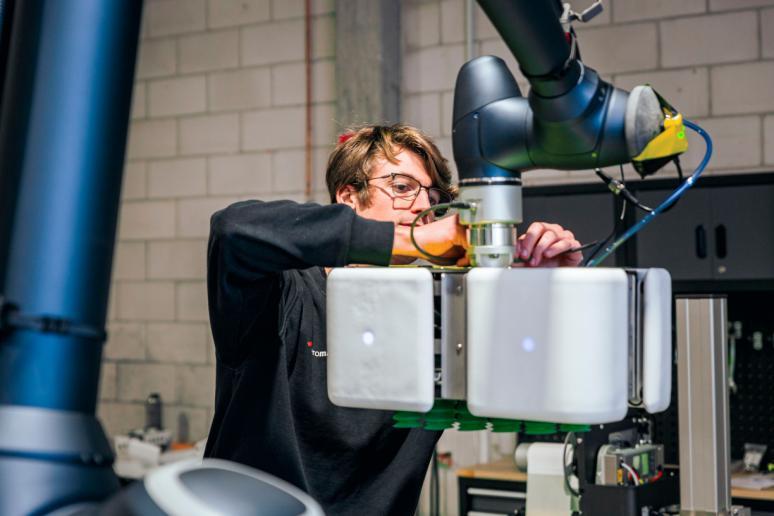
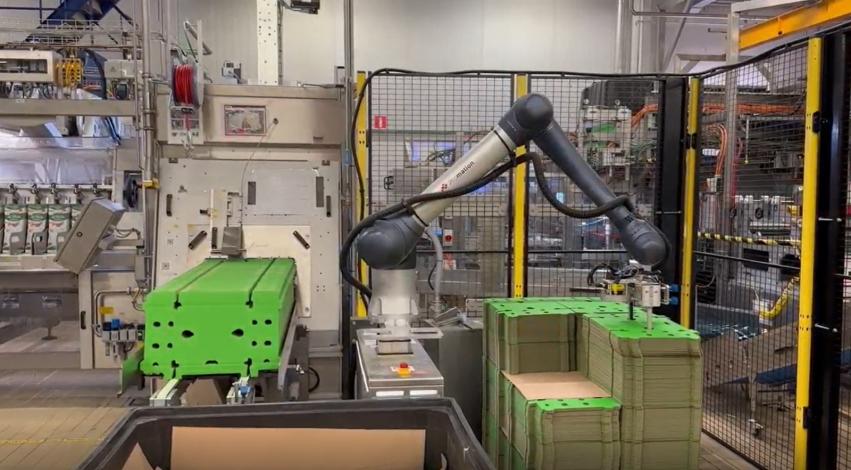
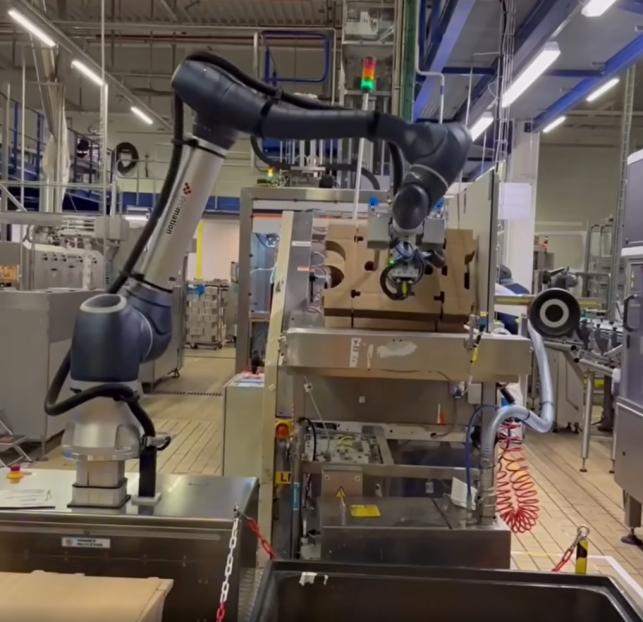
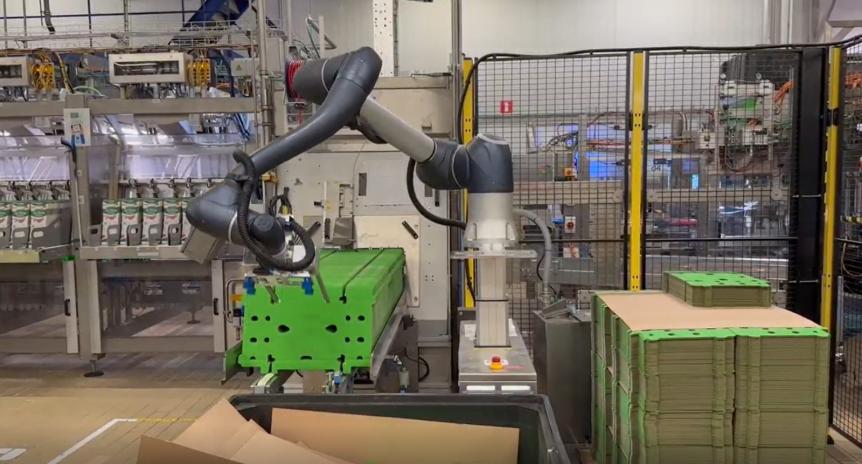
The Cofeeder is our own feeding robot: a cobot that provides a continuous supply of the material your other machines need to keep running. In a bottling plant, that means taking blanks from the pallet and keeping the magazine of your case packer or carton loader filled.
The technically difficult part is not the movement itself. It is picking from a stack of cardboard that is never perfect. Stacks are crooked, blanks stick together, heights vary, and there are interlayers between the layers that must not enter your machine. That is why our Cofeeder works intelligently through the stack, so that it does not damage the cardboard while still guaranteeing a constant supply. This is the kind of task where a conventional robot struggles without additional sensing technology.
For bottling plants, we have also developed gripping technology that works sideways between the blanks and safely keeps the interlayers separate. And for lines running so fast that a single cell cannot keep up, we install multiple cells that jointly supply one magazine, ensuring that feeding never becomes the limiting factor.
The Cofeeder rarely stands alone. It connects seamlessly with our other standard machines: the Cofiller, which fills packaging, and the Costacker, which palletises cases or trays. This allows you to cover the entire end of your line with one technology partner.
Discover the Cofeeder as a feeding robot
Why Promation specialises in this field
Carton feeding is not a side activity for us. It is the subject around which we built our product.
- The Cofeeder is a standard machine, not a one-off project. There are already many of them running on production lines in and outside Europe. Some customers ordered ten of them at once. That means you are not buying a prototype: you are buying a concept that has already been proven in practice, with a shorter lead time and a more predictable result than a custom-built solution.
- We know the challenges of cardboard. Crooked stacks, varying blank quality, interlayers, format changes between brands and pack formats, … These are the things that can make a feeding project fail, and this is where our development efforts have been focused in recent years.
- We do everything ourselves. Design, construction, installation, commissioning and maintenance. When there is a fault in your bottling plant, you do not have to call three different parties who point the finger at one another.
- We have all gripper variants in-house. Cardboard is unpredictable: every blank, every cardboard quality and every stack configuration behaves differently. That is why we test it. We take your blanks, try different gripper concepts and show you what works. And we do this quickly, physically and without months of preliminary studies. What you get is not an assumption on paper, but a gripper that we have actually seen handle your cardboard successfully.
- We calculate your speed realistically. Using our own tools, we calculate the effective cycle time of your feeding process, taking dozens of factors into account: number of blanks per minute, stack height, gripping time, interlayers, magazine capacity and pallet changes. This tells you in advance whether one cell is sufficient, instead of discovering it afterwards on your own line.
Let’s also be honest about what a Cofeeder does NOT do
We would rather sell you a correct expectation than a nice promise. So: a Cofeeder does not make your line faster. Your output is determined by your filler, not by your carton feeding. Anyone buying a Cofeeder expecting to run more packs per hour is buying it for the wrong reason.
What a Cofeeder does do is remove a cause of downtime and free up an operator for work where they can actually make a difference. The return on investment therefore comes from availability, labour hours and ergonomics, not speed.
And one more thing: if you run one shift per day on a low-speed line with a magazine that only runs empty twice per shift, the business case is weak. We will simply tell you that.
How to prepare: five things you need to know
If you want to automate carton feeding in your bottling plant, we mainly need these five things to give you a meaningful answer:
- Blanks per minute at maximum line speed: this determines whether one cell is sufficient.
- Formats and format changes. How many different blanks do you run and how often do you change them? Changeovers should be part of the design, not a workaround added afterwards.
- Pallet configuration. Dimensions, stack height and whether interlayers are used.
- Available space around the case packer, including the pallet supply route.
- Blank weight. The weight per blank and per stack that needs to be picked at once determines the cobot payload and gripper concept. This is the factor that is most often underestimated.
Conclusion: the packaging is decided, the feeding is not
The transition from plastic to cardboard in bottling plants is no longer really a choice. The PPWR will remove film around multipacks from the market by 2030, and the major brewers have been transitioning for years. What has not yet been decided in many companies is how that cardboard will reach the machine. As long as the answer is “an operator with a stack of blanks”, you are exchanging a packaging problem for an availability and ergonomics problem.
You now know why cardboard is entering your line, why feeding becomes the weak link and what a cobot such as our Cofeeder can change, including what it does not solve.

Written by Stijn Provoost
Founder of Promation. Passionate about programming and new technologies. With Promation, Stijn has one major goal: to improve production processes through industrial automation, robotics, and vision systems.
Want to know what that means for your line?
Briefly enter your situation in our ROI configurator and you will immediately see an indication of the solution and the payback period.
Would you rather first talk to someone who understands your bottling plant? Contact us for an honest analysis of your carton feeding. We will come and take a look, calculate along with you and give honest advice.